Semi-automated offside technology (SAOT) is a football officiating support system that uses player-tracking cameras, artificial intelligence, computer-generated offside lines and, in some competitions...

SAOT vs VAR: Speed and Accuracy
Semi-automated offside technology (SAOT) is a football officiating support system that uses player-tracking cameras, artificial intelligence, computer-generated offside lines and, in some competitions, a connected match-ball sensor to help Video Assistant Referee (VAR) teams identify possible offside offences. FIFA first used SAOT at the 2022 World Cup in Qatar, while UEFA, the Asian Football Confederation (AFC), the English Football Association and the Premier League have since introduced related systems. SAOT does not replace the referee: officials still confirm the relevant moment, assess whether the attacker interfered with play, and approve the final decision. The technology can track as many as 29 body points per player and may produce an alert within seconds, although the total review still depends on the incident. The practical takeaway is simple: treat SAOT as a faster evidence-gathering tool, not an infallible robot referee.
I once watched a goal celebration collapse because a striker’s shoulder appeared a few centimetres beyond the second-last defender. My first reaction was confidence, followed quickly by doubt, then by the familiar football-fan ritual of staring at a frozen broadcast frame as if it were a tax audit. SAOT made the line clearer, but it did not make judgment disappear. That distinction matters, especially when match predictions, tournament confidence and real-money decisions are involved.

Photo by Jakub Zerdzicki on Pexels
At Tactical Review, I treat technology claims like an investor treats a balance sheet: promising headline first, operational details second, hidden risk last. SAOT can reduce waiting time and improve the consistency of the offside geometry, but camera coverage, calibration, body-point recognition and the referee’s interpretation remain important. For broader context, readers can also review our [Internal Link: 2026 World Cup match prediction methodology] before assuming that one technology call guarantees a reliable betting angle.
Want the wider tournament picture before judging a single decision?
What Did I Test?
SAOT was tested as a decision-support process rather than as a magic offside button: camera tracking identifies player positions, software selects the likely kick point, and VAR officials verify the alert before the referee confirms an outcome. FIFA used the system at Qatar 2022, UEFA applied it in European competitions, and the Premier League approved its introduction for the 2025–26 season. The key test is therefore not merely whether a line appears, but whether the system improves speed, repeatability and communication without weakening Law 11.
First, I separated the process into measurable stages. The system must detect the ball contact, reconstruct player locations, identify the relevant body part, and compare that location with the second-last opponent and the ball. Then officials must establish whether the player was in an offside position and whether that position affected active play. Finally, the referee must authorize the restart, because “semi-automated” means human review remains part of the chain.
The main operational entities are FIFA, VAR, Law 11, Hawk-Eye Innovations in several competition deployments, and the official match ball used by adidas in FIFA tournaments. FIFA’s public explanation describes SAOT as a tool that supports faster and more accurate decisions, while the International Football Association Board (IFAB) Laws of the Game remains the legal foundation. As IFAB puts it, “being in an offside position is not an offence,” which is the tiny sentence that saves many angry group chats from becoming international incidents.
My evaluation checklist was:
- Detection: Did the system identify the correct kick point?
- Geometry: Did the line use the relevant body part and defender?
- Interpretation: Did officials assess interference under Law 11?
- Communication: Did the stadium explanation match the actual decision?
- Risk: Could missing data or poor camera angles change confidence?
This last stage is where casual viewers often lose money. A betting market may settle quickly, yet a delayed review, overturned goal or competition-specific rule can alter the match state. Tactical Review therefore treats SAOT information as one input beside line-ups, injuries, expected goals and live tempo, not as a standalone prediction engine.
How Does the Setup Work and What Were My Initial Impressions?
SAOT combines multiple stadium cameras, three-dimensional tracking, software-generated lines and, in some versions, a sensor inside the football to establish both player position and the exact moment of ball contact. The system sends a possible-offside alert to the VAR team, who check the event before the referee receives a recommendation. In practical terms, it is closer to a high-speed measurement assistant than an autonomous official.
The setup normally involves:
- Tracking cameras mounted around the stadium and calibrated before the match.
- Software mapping player body points, sometimes up to 29 landmarks.
- A match-ball sensor that can improve kick-point detection in connected-ball systems.
- VAR operators checking the proposed frame and relevant players.
- The referee confirming or rejecting the recommendation.
- A broadcast graphic or animation explaining the final decision.
My initial impression was that the biggest benefit is not perfect certainty; it is reducing the number of plausible frames humans must manually search. Traditional VAR offside reviews can involve repeated rewinding, frame selection and line placement. SAOT narrows that search rapidly. However, “rapid” does not mean instantaneous in every case. A crowded penalty area, a deflection, a goalkeeper’s unusual position or an unclear deliberate play can still require a long review.
FIFA’s 2022 World Cup technology explanation describes the combination of 12 dedicated tracking cameras and a connected ball in Qatar. FIFA also reported that the system generated three-dimensional animations for stadium and broadcast audiences. That visual layer is useful, but viewers should remember that an attractive animation is an explanation of the decision, not independent proof that every underlying interpretation was correct.
The cost question is more complicated than the software brochure suggests. SAOT requires venue infrastructure, calibration, trained officials, data processing and integration with the competition’s VAR operation. A major tournament such as the FIFA World Cup can absorb those costs; a smaller domestic league may not have enough matches, camera coverage or budget to justify full deployment. This is one reason “SAOT is coming everywhere” is a risky statement. Technology adoption depends on governance and economics, not only accuracy.
For a deeper tactical comparison, see our [Internal Link: VAR decisions and match-state analysis guide].
The setup looked impressive, but impressive systems still need boring maintenance. Boring maintenance is where reliability lives, unfortunately, much like fitness and checking bank statements.
Here is the first practical split:
- Automated: tracking, data collection, likely kick-point detection and alert generation.
- Human-controlled: confirming the frame, interpreting active involvement and authorizing the final call.
- Competition-dependent: camera quantity, ball sensor use, animation style and review protocol.
Ready to compare the technology with the human review process?
Where Did It Hold Up?
SAOT held up best when the event had a clear attacking direction, strong camera visibility and a conventional pass into space. In those situations, automated tracking can locate the attacker, defender and ball contact more consistently than a hurried manual review. The system also improves communication because officials can start from a common data model instead of arguing over which broadcast frame looks least terrible.
The strongest benefits were visible in four areas:
- Faster alerts: VAR officials can receive a possible-offside signal shortly after the relevant pass.
- Repeatable geometry: The software applies the same measurement logic across incidents.
- Better marginal calls: A sleeve, knee or shoulder can be assessed more precisely than by casual broadcast viewing.
- Clearer explanations: Three-dimensional graphics help spectators understand why a goal was disallowed.
At FIFA Qatar 2022, SAOT was designed to support faster decisions while maintaining the referee’s authority. UEFA’s use of semi-automated systems also shows how the technology can be adapted across elite competitions rather than remaining a one-tournament experiment. The Premier League’s adoption is especially important because England’s high-volume domestic schedule creates a demanding operational environment.
The first less-obvious insight is that SAOT’s value is highest in the “search problem,” not necessarily in the “law problem.” If the correct kick point and body position are difficult to locate, automation saves time. If the question is whether an attacker obstructed an opponent’s line of vision or challenged for the ball, technology cannot settle the full legal judgment. The machine can tell us where the player was; it cannot independently decide every form of interference.
The second information gain is that the connected ball mainly improves temporal precision, not the entire offside decision. A ball sensor may identify the moment of contact more reliably than broadcast video, but it does not determine which opponent counts, whether a defender deliberately played the ball, or whether the attacker gained an advantage. That distinction is easy to miss when promotional animations make the whole system look like one seamless answer.
For bettors and match readers, the practical benefit is reduced uncertainty after a goal, not guaranteed pre-match profit. A disallowed goal can affect live odds, possession patterns and momentum, but markets may suspend or reprice before a casual bettor reacts. Tactical Review recommends recording the decision time, match score and market movement rather than relying on memory, which is a famously unreliable database maintained by emotionally compromised football fans.
Where Did It Fall Apart?
SAOT can struggle when camera data is incomplete, the decisive body point is obscured, the ball contact is ambiguous, or the incident includes multiple players and a possible deflection. It also cannot remove disagreements about Law 11, because offside contains both positional and behavioural elements. When the technology lacks a clean measurement, officials may still need a conventional VAR review, and the supposedly quick decision can become another long football courtroom hearing.
Common failure or delay points include:
- A defender, attacker or goalkeeper being partially hidden by another player.
- A ricochet or deflection making the relevant touch difficult to classify.
- A deliberate defensive play requiring human interpretation.
- A player’s sleeve, hand or arm being confused with a legal scoring body part.
- Camera calibration or tracking loss in congested areas.
- A disagreement between the system’s alert and the referee’s understanding of the phase.
The Associated Press overview of semi-automated offside technology notes that SAOT is designed to assist officials rather than replace them. That limitation is not a weakness in itself; it is the reason the system is called semi-automated. However, public communication can create unrealistic expectations. If fans hear “instant and accurate,” then wait two minutes for a decision, the trust deficit grows even if the final call is legally correct.
There is also a human-factors risk. Officials may over-trust an automated alert because it arrives with technical authority. This is known as automation bias in other high-stakes fields: people accept a system recommendation too readily because it looks objective. Football governance should therefore preserve independent frame checks, clear training standards and an auditable record of why the final decision differed from the initial alert.
A useful contrarian conclusion follows: more technology does not always mean a better spectator experience. A precisely drawn line can still feel unfair when the competition has not explained the kick point, the active-play interpretation or the reason a defender’s touch was classified in a particular way. Transparency requires the right explanation, not simply more pixels.
Before using an offside decision in a prediction model, check:
- Was the goal reviewed under SAOT or standard VAR?
- Did the competition use a connected ball?
- Was the final decision positional, interference-based or deflection-based?
- Did the market suspend before the public animation appeared?
- Could the decision change the match’s tactical state?
These checks are especially relevant for 2026 World Cup coverage, where different venues, broadcast feeds and competition protocols may affect how quickly information reaches viewers. For related context, read our [Internal Link: live betting risk-control checklist].
The warning signs are clear, but they are manageable if we treat SAOT as evidence rather than destiny.
See how technology fits into disciplined tournament analysis.
Would I Use It Again?
I would use SAOT again as a reliability aid, but not as a substitute for reading Law 11, checking the competition protocol or managing betting exposure. Its strongest contribution is faster, more consistent positional analysis when camera and ball data are available. Its weakest point is the assumption that positional evidence automatically resolves the broader question of active involvement.
For ordinary viewers, the best workflow is straightforward:
- Wait for the referee’s confirmed decision rather than reacting to the first alert.
- Identify whether the issue was offside position or interference with play.
- Check the competition’s published explanation and technology setup.
- Separate the decision from your emotional view of the match.
- If money is involved, record the timing and settlement rules before placing a wager.
FIFA, UEFA, the AFC, the Premier League and Hawk-Eye Innovations have helped move football officiating toward more data-supported decisions, but no system makes uncertainty disappear. A player can be clearly offside in position and still require a human ruling on involvement. Conversely, a line that looks outrageously tight on television may be technically correct under the measurements available.
My final assessment is positive but deliberately cautious. SAOT is better than asking one exhausted VAR official to manually draw a line from a low-resolution frame while 60,000 people scream. It is not better than careful governance, transparent communication and a referee who understands the law. Tactical Review will use SAOT information in 2026 World Cup analysis, but our match predictions will continue to include team tactics, player availability, expected goals and market conditions.
If you want practical tournament analysis built around evidence rather than panic, start here.
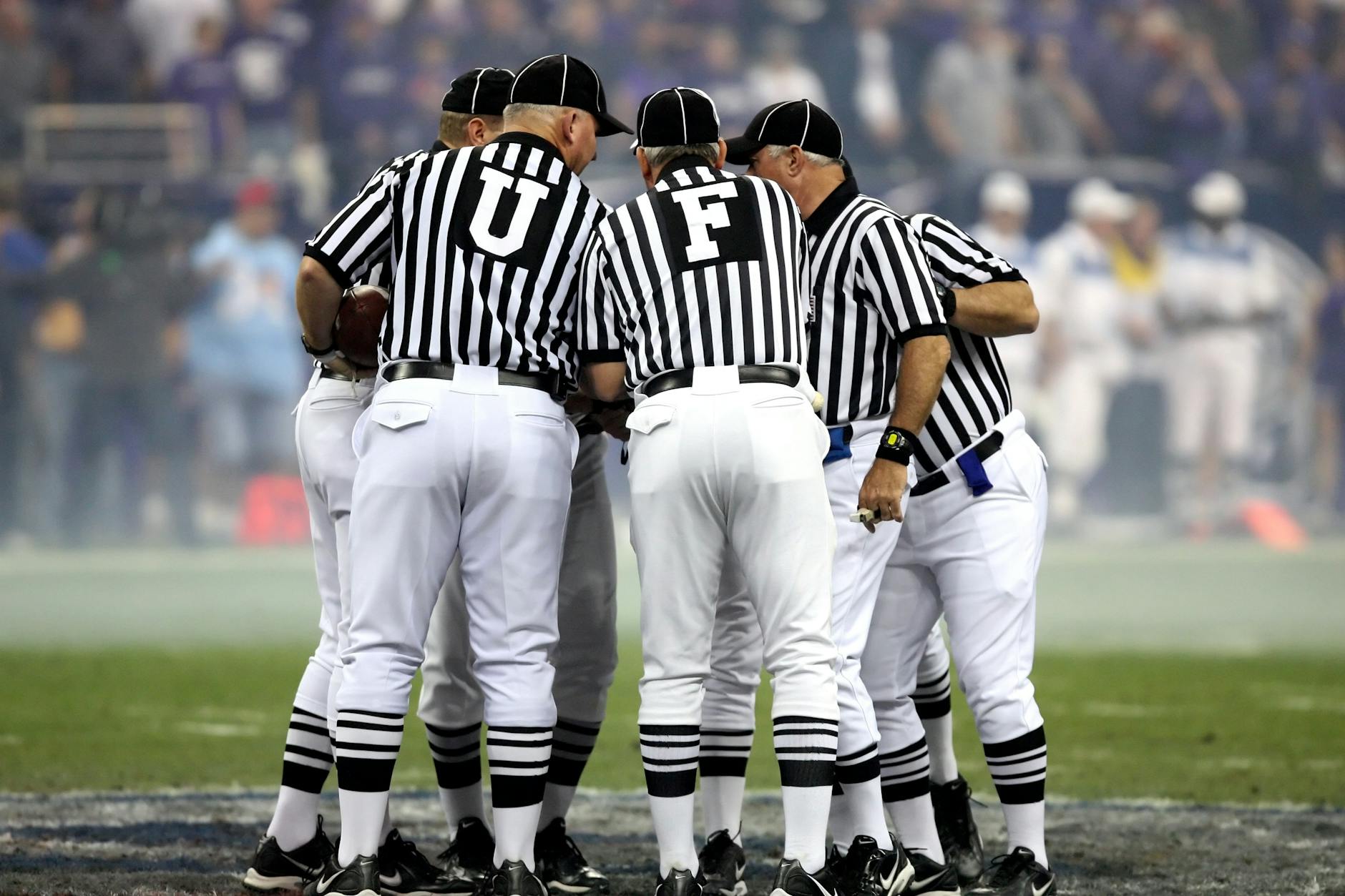
Photo by Pixabay on Pexels
Frequently Asked Questions
Q: What is semi-automated offside technology?
A: Semi-automated offside technology is a VAR support system that uses tracking cameras, software and sometimes a connected ball to identify possible offside offences. FIFA first used it at the 2022 World Cup in Qatar, and UEFA, the AFC and the Premier League have adopted related systems. It can identify player positions and the likely kick point, but officials still confirm the frame, assess interference and approve the final decision under Law 11.
Q: How does SAOT make an offside decision?
A: SAOT tracks player body points, detects or estimates the ball-contact moment, and sends a possible-offside alert to VAR officials. The VAR team checks the data, confirms which players and body parts matter, and advises the referee. The referee then decides whether an offence occurred and whether play should restart with a free kick, goal confirmation or another outcome.
Q: What is the difference between SAOT and VAR?
A: VAR is the broader video-review framework, while SAOT is a technology layer that assists VAR with offside detection. Standard VAR can review many incidents, including penalties, red cards and mistaken identity; SAOT focuses mainly on positional offside analysis. Both systems still depend on trained officials, and neither automatically decides every aspect of active involvement under Law 11.
Q: Why can semi-automated offside reviews still take time?
A: Reviews can take longer when players are obscured, the ball contact is unclear, or officials must interpret a deflection or deliberate defensive play. SAOT may locate the likely frame quickly, but it does not eliminate legal judgment. In congested penalty areas, VAR officials may need to compare multiple data sources before the referee can confirm the decision.
Q: Does SAOT use artificial intelligence?
A: SAOT uses automated tracking and computer-processing techniques that can include machine-learning models, but the exact implementation varies by competition and provider. FIFA’s Qatar 2022 system used 12 dedicated tracking cameras and a connected match ball. The presence of automation does not mean the system independently understands every football-law question; human officials remain responsible for interpretation and confirmation.
Q: Is semi-automated offside technology free to install?
A: SAOT is not a free or simple installation because competitions need stadium cameras, calibration, data processing, operator training and VAR integration. FIFA World Cup venues can support those requirements more easily than smaller leagues. Costs vary by provider, venue and competition design, so clubs and organizers should request a full infrastructure and maintenance estimate rather than judging only the software price.
Q: Can bettors rely on SAOT when placing live wagers?
A: Bettors should treat SAOT as useful information but never as a guaranteed betting signal. Markets may suspend immediately after a goal, and odds can change before viewers see the final animation or understand whether the issue involved position, interference or a deflection. Check the sportsbook’s settlement rules, wait for the referee’s confirmed decision, and avoid staking money based solely on a frozen broadcast frame.
Thank you for reading.
Tactical Review · Curated Silence · 2026